
By the Closer Look Inspectors team · Facts checked October 2026 against the sources listed below · About our inspectors
A commercial inspection of an apartment building with five or more units documents the building's condition so buyers and owners can plan repairs and capital spending. Five units is the line: InterNACHI's home inspection standards stop at four.
Get Your Free Instant QuoteCall or text (612) 457-1634
Apartment buildings (5+ units)
Why five units is the line
Fannie Mae's and Freddie Mac's multifamily guides both start at five dwelling units.
Federal energy statistics draw the same line. The U.S. Energy Information Administration's 2020 Residential Energy Consumption Survey (RECS), a national survey of households, reports apartments in buildings of five or more units separately from apartments in two-to-four-unit buildings. It estimated 22.84 million of the former among 123.53 million occupied primary homes nationwide.
Home inspection standards stop where that line starts: InterNACHI's apply to properties with four or fewer residential units.
If a lender is involved, ask what kind of condition report it accepts before the inspection is scheduled.
An older housing stock
Much of this housing is not new. In the same 2020 national survey, 3.08 million apartments in buildings of five or more units were built before 1950, and the largest decade group, 4.01 million, dates from the 1970s. In the West North Central division, which includes Minnesota and Iowa, the survey estimated 1.26 million such apartments.
Age brings moisture and maintenance questions. The National Park Service calls uncontrolled moisture the most prevalent cause of deterioration in older and historic buildings, and notes that deterioration can accelerate when the building envelope is not maintained on a regular basis. Routine and preventive care, the Park Service adds, is the most effective way of slowing the natural process of deterioration, and well-maintained properties tend to suffer less damage from storms and high winds.
Brick walls and mortar joints
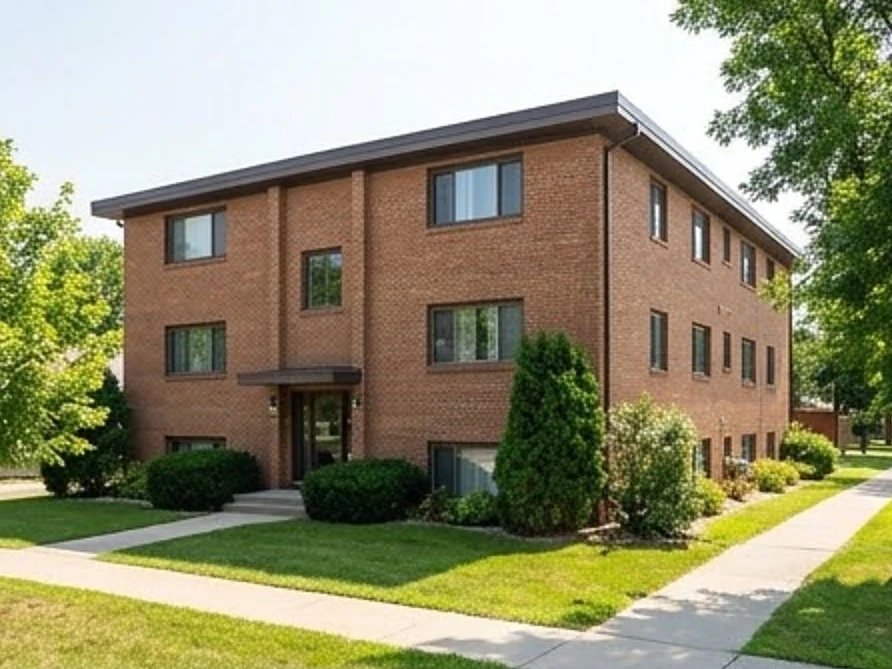
The exterior walls are a large part of the building envelope. In the same 2020 survey, brick is the major outside wall material for 9.80 million apartments in buildings of five or more units, against 3.79 million for siding. The Park Service notes that masonry is subject to deterioration, especially at the mortar joints.
Heating plants and shared systems
Heating equipment is often a large part of the capital plan. In the same 2020 national survey, 8.65 million apartments in buildings of five or more units had a central warm-air furnace as their main heating equipment, 4.19 million had built-in electric units, 2.87 million had heat pumps, and 2.80 million had a steam or hot water system. Age is part of that picture too: 6.91 million had main heating equipment that was 20 or more years old.
The National Park Service says the need for modern mechanical systems is one of the most common reasons to undertake work on historic buildings, and that historic buildings are not easily adapted to house modern precision mechanical systems. For a buyer, the age of the roof, heating plant, and electrical service is a large part of the picture.
Talk through a specific building
Commercial thermal imaging is described on its own page. Closer Look Inspectors provides commercial property inspections for apartment buildings with five or more units in Minnesota and Iowa. Describe the building and request a quote.
Related
Towns we cover
Quick answers
Is a four-unit building commercial?
A four-unit building falls within InterNACHI's home inspection standards, which apply to properties with four or fewer residential units. The commercial side starts at five units.
How many apartments are in buildings with five or more units?
EIA's 2020 national Residential Energy Consumption Survey estimated 22.84 million occupied apartments in buildings of five or more units, out of 123.53 million occupied primary homes, with 1.26 million in the West North Central division, which includes Minnesota and Iowa.
Which decade built the most apartments in buildings of five or more units?
In EIA's 2020 national survey, the 1970s: 4.01 million apartments in buildings of five or more units date from that decade, the largest decade group, and 3.08 million were built before 1950.
How old is the heating equipment in larger apartment buildings?
In EIA's 2020 national survey, 6.91 million apartments in buildings of five or more units had main heating equipment that was 20 or more years old, and 2.80 million were heated mainly by a steam or hot water system.
Why is moisture such a concern in older apartment buildings?
The National Park Service calls uncontrolled moisture the most prevalent cause of deterioration in older and historic buildings. It results in erosion, corrosion, and rot, which is why roofs and drainage matter early.
Sources
- Fannie Mae Multifamily Guide: Part II, Chapter 1, Eligible Properties
- Freddie Mac Multifamily Seller/Servicer Guide: Glossary
- U.S. Energy Information Administration: RECS terminology
- U.S. Energy Information Administration: 2020 RECS Table HC2.1, Structural and geographic characteristics of U.S. homes, by housing unit type
- InterNACHI: Home Inspection Standards of Practice
- National Park Service: Preservation Brief 39, Controlling Unwanted Moisture in Historic Buildings
- National Park Service: Preservation Brief 47, Maintaining the Exteriors of Small and Medium Size Historic Buildings
- National Park Service: Preservation Brief 2, Repointing Mortar Joints in Historic Masonry Buildings
- U.S. Energy Information Administration: 2020 RECS Table HC6.1, Space heating in U.S. homes, by housing unit type
- National Park Service: Preservation Brief 24, Heating, Ventilating, and Cooling Historic Buildings
Looking at apartment buildings (5+ units)? Build a free instant quote, or call or text (612) 457-1634.
Get Your Free Instant Quote